Abe Lyman-That’s My Weakness Now

Another day, another energetic tune. Abe Lyman was born Abraham Simon but changed his name (along with his brother) because they thought “Lyman” sounded better. Beginning in Chicago, Lyman would find success out west in California. His aforementioned brother Mike opened a LA club that became popular with movie stars and other celebrities. Of course, this being Hollywood of the 1920s, the bad-behavior ban hammer was about to come a’knockin. When it did, the Hollywood stars had to sign onto contracts stating that they would not be seen near or inside a club. Mike’s club was an unfortunate victim of this crackdown. Yet, Abe had experienced tremendous success performing there with his nine piece orchestra. He was able to move his act to more respectable venues and soon put in appearances on the radio. Along with cutting his first records, these factors allowed his notoriety to take off. From there, Lyman would provide music for early film, some Warner Brothers cartoons and radio shows. In 1947, at the age of fifty, Lyman would retire from the music business altogether. He died ten years later. Today’s featured tune is a peek into his group’s energy and talent.

A 1928 recording, That’s My Weakness Now was composed by Sam Stept. The song begins with and maintains a playful attitude. Special mention must be made of the piano interlude in the middle of the piece-I realize I focused on the piano last post, but hey, I have to recognize a good sound when I hear it. After all, just following the piano is a brief wind solo that is fantastic. As the piece comes to a close you can still make out the solo instrument in the background. The tune’s rhythm lends itself well to dancing, something Stept must have had in mind. These faster pieces tend to go by too quickly, and it can be easy to miss the little subtleties. Yet, like any work of art, it can be nice to listen through it at a slower pace, trying to pick up on each little morsel the performer has left in his wake. A careful ear is an appreciative one. Long after the jazz greats have gone, appreciation is a key factor in keeping them around.

Art Tatum-Sophisticated Lady

While the benefits of a full band or orchestra were made quite clear during the jazz age, today’s subject shows that sometimes all it takes is a single proficient performer and a lone instrument to convey beauty. The piano emerged as a fast favorite of the jazz sound, and Art Tatum was one of the greats. Tatum had perfect pitch from childhood, and so was able to learn to play by ear. He had to work diligently in order to overcome blindness in one eye, and poor vision in the other. After a time of classical training, that discouraged jazz, Tatum was able to play on the radio. Here, his adversity became a sort of asset, earning him the attention of jazz greats like Duke Ellington and Fletcher Henderson.

1932 saw Tatum’s introduction to New York City. He would be able to call it one of his base cities as his career continued to flourish. Tatum was able to have to have stints in Toledo, Cleveland, St. Louis and Chicago. Supplementing these with radio appearances, the Thirties were Tatum’s heyday. By the Forties, however, tastes had begun to change and his career suffered somewhat. Today’s song hails from his earlier days (1933, to be precise).

A Duke Ellington composition, the song begins with a peppering of notes, indicative of the clipped manner Tatum will approach playing. This style could easily meander into the random and unfocused. Yet, under Tatum’s supervision, it is evident that every note played is part of a deliberate calculation. If a nit-pick can be made about Tatum’s style, it is that the song doesn’t rhythmically coalesce until over a minute in. It is at this point that the streams of notes support the foundational rhythm. Prior to this, the melody comes at the listener in fits and starts. Fits and starts with talent, yes, but they take some getting used to. Taken in as one piece, “Sophisticated Lady” is one smooth listen.

Paul Whiteman/Mildred Bailey-I’ll Never Be The Same

Paul Whiteman’s career in music began in earnest at the dawn of the 1920s. By the middle of that decade he had earned himself the nickname “King of Jazz”. A bandleader, Whiteman took the position that jazz could be bettered through arrangement, where other saw pure improvisation as jazz’s true strength. Despite, or perhaps because of the “controversy” Whiteman’s arrangements and recordings were well received. His orchestra sought out fresh talent. One such case of talent was Mildred Bailey, signed by Whiteman to perform on his radio show. Bailey was born Mildred Rinker, and was Native American on her mother’s side. She kept the name of her first husband after they divorced, and it was Mildred Bailey who helped Bing Crosby start his career. Crosby, out of gratitude, introduced her to Paul Whiteman. This song was a 1932 release.

The long instrumental introduction on the track demonstrates the power of Whiteman’s lavish arrangements. They are absolutely fantastic at setting a mood. This song quickly establishes a sense of sentimental calm. This sense of calm is shaken up the lyrics, that speak of love gone wrong. Bailey absolutely nails the emotions of a lover who will never be the same since they parted from their other half. For the singer “stars have lost their meaning” and love was a “king” in her life, but she sadly notes that “kings can be wrong”. This exploration of heartache is brief, yet thorough all the same. As the lyrics conclude, the orchestration returns to guide the listener through the rest of the journey. The instrumentation almost serves as a comforting, quieter sound after Bailey’s powerful performance. The melancholy that was lurking just under the surface is free to exhibit itself, but its subdued manner allows the listener to relax.

https://www.youtube.com/watch?v=o1s8EZU5Xjc

Delightful Diversions 3: Jazz Age Lawn Party @ Governor’s Island, NYC

Save for times when I took in theatre and classical music as a child, it took until I was an adult to venture out to hear “my music”. The notion of hearing something live and in person is such a game changer-it gives you a wave of energy and reaffirms what it is about that music that you love. With the music of the early 1900s, I figured it would be an uphill battle to find places and performers resurrecting the sounds of the past. After some fervent searching, I came across the annual Jazz Age Lawn Party, held twice a summer on Governor’s Island, in New York City. I just knew I had to go and see what it was all about. At long last, this past Saturday, that’s exactly what I did.

One MegaBus and ferry later, I was on Governor’s Island following the line to the Party’s ticket takers. I had seen hints of period dress on the ferry, but the sight that greeted me on the island was amazing. IMG_0209.JPG

A line of finely dressed flappers and gentlemen stood before me. In my modern dress and sneakers, I wasn’t breaking a dress code, but I felt a slight pang of guilt nevertheless. Once I had taken this in and the line had moved up, I moved with my program to find the main stage. I was soon seated to experience the first part of the entertainment.

IMG_0213.JPG

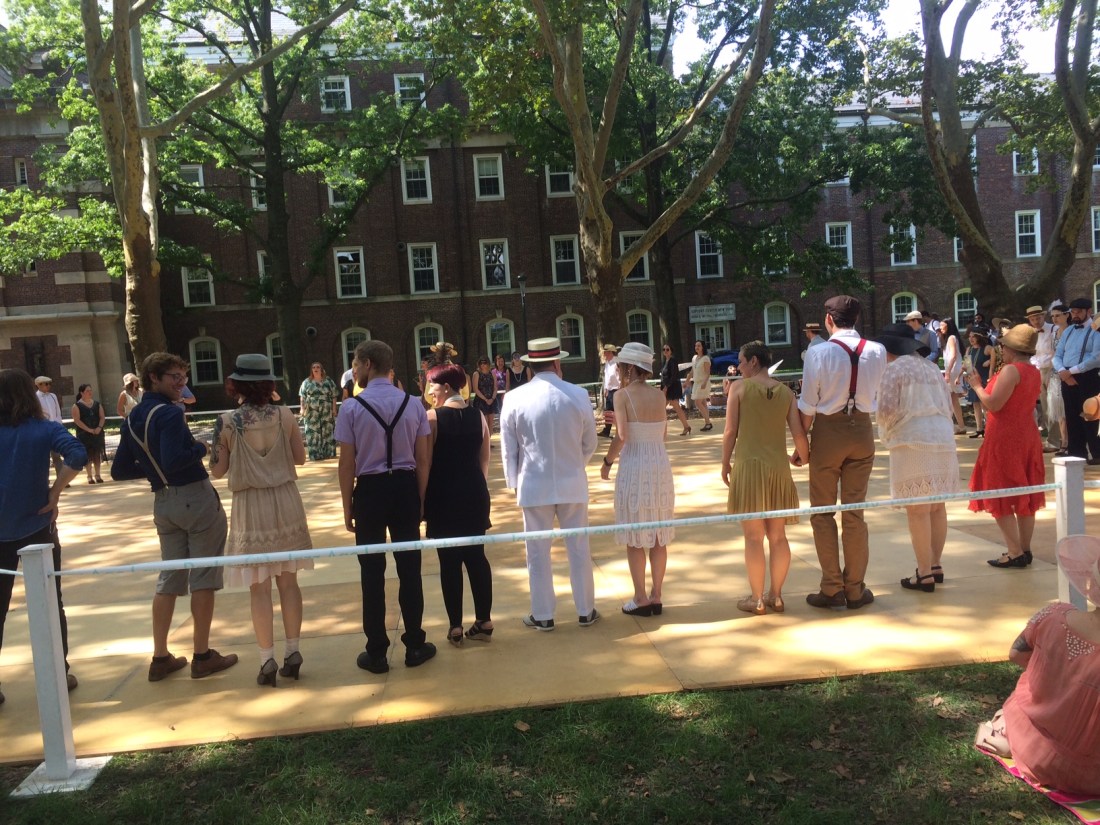
The first order of business was to teach those who were willing, and able, to Charleston. On hand for this endeavor was Roddy Caravella. From what I witnessed, those who learned could not have asked for a better teacher. Caravella has been teaching and performing jazz dance for the past 25 years, and has been part of the Lawn Party since it began 13 years ago. Caravella began slowly, giving his charges the easier steps. He then eased them into rougher waters. Soon, however, all were dancing like they were born for the task.

IMG_0210.JPG

Pictured: The awkward beginnings.

After this, the star of the Lawn Party took to the stage. Michael Arenella is the founder of the Lawn Party, leader of His Dreamland Orchestra and an amazing performer. He painstakingly transposes actual music from the 1920s and his orchestra performs it. People who had just learned (or had a refresher) were dancing, Roddy’s dance troupe, the Canarsie Wobblers, performed, and there was an electricity in the air, coming from the music.

I’ve inserted a (very) brief clip of the dancing and music. It is but a small sample of the wonder I found on Governor’s Island that day. I am definitely going back to the Lawn Party next year. It is keeping the sounds of the 1920s alive and very well.


Ben Bernie and His Orchestra-Rhythm King

By the time he recorded “Rhythm King”, Ben Bernie had already made it big in Vaudeville, co-written “Sweet Georgia Brown” and had a few other #1 hits to his name. He had also participated in the first broadcast of NBC (as a radio station). Bernie’s radio broadcast career was very much intertwined with his recording career, as his musical variety show would begin in the 1930s. This composition of his was released in 1928. It serves as a wonderful demonstration of why Bernie had earned such attention by this point. His charisma was apparent, and his composition work is very calculated and deliberate.

This track doesn’t waste much time with an instrumental introduction, it leaps right in to inviting the audience to listen to “the rhythm king” and how each instrument will cause them to “rock like a chair”. The middle section of the song features some wonderful scatting over sparse instrumentation, but soon lapses so the listener can appreciate the rhythm king’s work. What follows does not dissapoint-while it is a tad brief, the energy of what is being presented is so lively that it backs up what the orchestra has been promising. The blend of the instruments here proves that Bernie and his bandmates had an acute understanding of what made this genre tick, and that their leader’s work on Vaudeville had evolved and paid off. The lyrics compliment the melody, and do not distract the listener with a separate story. Here, the music IS the story. In that sense, it is different from all else I’ve covered here thus far. Perhaps its a tad about ego, and Bernie acknowledging the power he wielded over an audience. Yet, it could still be read as an ode to the power of jazz to render audiences captivated. Here’s hoping it continues to captivate.

Delightful Diversions 2/Ada Jones/Billy Murray: Come Josephine In My Flying Machine

To begin this post, I can offer no other introduction than to say God bless Joel Whitburn. Through years of careful dedication and a team of professionals, the man has taken a fine tooth comb to the history of American popular music. From its roots to its emergence onto the Billboard charts, it’s all been catalogued by Mr. Whitburn. Even back when this hobby was but a twinkle in the eye of yours truly, I knew that eventually I would have to get my hands on one of his tomes. Well I finally achieved that mission, and received this in the mail for my troubles

IMG_0201.JPG

As stated on the cover, it details the songs and artists that made up the hit music from 1900-1940. This book’s largest section is listed by artists alphabetically, with their hit songs listed below. There is so much to grapple with between its covers, and quite a few songs listed within will definitely get an analysis here. With that, hey look! An incoming analysis!

The year was 1910. The aviation era was new. Aircraft was around a year from being first used in warfare. Aviation had become a craze among Americans and Europeans, with the technology being shared between the continents. The ground was fertile for a catchy tune about the subject. Enter “Come Josephine in My Flying Machine” by Fred Fisher and Alfred Bryan. This version, by popular vocalists Ada Jones and Billy Murray, was recorded in November, 1910 but released the following year. Ada Jones was one of the pioneer female recording vocalists, while Billy Murray had become a legend in his own right. Jones had recorded another version within the same year, but this version is a standout.

As planes had yet to deal with any sort of horror (save for the danger that befell early pilots and scientists) the lyrics are free to dwell in a land of pure whimsy. The singer entreats Josephine to join him in his “flying machine”. This sounds, to the modern listener, as if someone had called a train or car a “horseless carriage”. Yet one can hear the feeling of flying in the jaunty instrumentation. Both music and lyric encapsulate the feeling of impressing one’s sweetheart with a ride in your newfangled plane, and marveling at how close the heavens feel. When something is so new, why shouldn’t it be celebrated? Our turn of the century counterparts had a handle on celebrating the new through music. May that trait never fade.


Aileen Stanley-I Ain’t Got Nobody To Love

Time to shift the spotlight back to the fairer sex. Today’s artist is someone who overcame adversity to make it in the music industry of the early 20th century. Aileen Stanley, whose given name was the decidedly unjazzy Maude Elsie Aileen Muggeridge, was raised by a single, widowed mother. Maude was quick to discover Vaudeville, and while her brother performed with her at first, she soon broke out when he left their act. Her stint led her to (where else?) New York City, where her prowess on the revue stage led her to a recording career. After the onset of the Great Depression, she moved to England, where her parents had hailed from. After her recording career had gone by the wayside, she worked as a vocal teacher. She would pass away in 1982 in Los Angeles, aged 89.

The song is a lamentation that the singer lacks love in her life. She doesn’t lack for proper housing, pets, furniture and incense. The furniture referred to in the song, the Morris chair was one of the earliest forms of the recliner. Winding the clock back to the 1920s, this was the apex of luxury. The singer also laments that time seems to be passing her by. She even mentions that her friends and acquaintances will vouch for her being nice, and worthy of lasting love. The song’s core message and timing are quite interesting-this seemed to be at a time when the economy could do no wrong, and the acquisition of goods was very much en vogue. This song doesn’t condemn the lifestyle of acquisition, yet still not so subtly implies there is more to happiness than simply “having it all”. A message that needed to be heard then, and can still be taken to heart now.

Richard Himber-My Dancing Lady

One of the interesting bits of trivia I have encountered time and again is the fact that an artist or bandleader had already been famous by the time they thought to put their work onto records. If not for the record, the music loving public would have only performances and sheet music to go on for how good (or not so good) a song or tune was. Mass produced disk records were so much of a shakeup for the music industry. So while today’s recording comes from the near beginning of the record releasing career of Richard Himber, he was, by the early 1930s, already an established fixture in the artistic community.

Growing up in the dawn of the 20th Century, Himber proved quickly he had a mind for music. His parents were not the encouraging sort, and upon encountering him playing at a Newark, New Jersey dive, confiscated his violin and sent young Richard away to military school. This only deterred him temporarily, for by 1915 he was freshly arrived in New York City. There, he proved a savvy businessman, working with artists to book acts for private functions. 1932 saw Himber start his own orchestra, with the following year marking his foray into record making. Aside from musical and business talent, Himber was also a magician and had a wicked sense of humor. He would pass away following a heart attack in 1966.

Moving along to the piece at hand, it’s a 1933 composition from the film “Dancing Lady”. Though not the standout song from the film, the lyrical content is about on par with much later popular music about one’s dancing partner and romantic interest. The song promises the dancing lady that there’s “nobody like her” and that soon the singer and his dancing lady will be wed. The song’s earnest, simple sentiment is a real winner. Himber’s orchestral handling of the tune demonstrates his talents, which made him such a formidable player in the music game.

Caroll Gibbons and The Savoy Hotel Orpheans: Better Think Twice

Today’s song and performer brings us a tale of an Anglophile. Caroll Gibbons was born and raised in Massachusetts, but life gave him an early opportunity to study in London. It seems a single taste of the city was not enough for Gibbons, as he returned in 1924 and got to play at the Savoy Hotel. He became the co-leader of the Hotel Orpheans and outright leader of the New MayFair Orchestra. The 1930s became quite the active decade for Gibbons, as he came back to the USA ever so briefly to compose for MGM films. His true home, however, was the UK and he became sole leader of the Orpheans. After his bright star had faded somewhat, Gibbons would marry in 1951, but pass away from a heart attack in 1954. “Better Think Twice” hails from his most successful and prolific artistic period.

The speed and energy of “Better Think Twice” is a key tool for the Orpheans to hook the listener. The vocals don’t take too much time to appear, and sing of a love that may or may not be ending. The singer implores his sweetheart to “think twice” before calling things over and done. After all, she knows “what she’s got” with him. As for how to think through the relationship, with all its complexities? The singer has an easy answer: “stop and count to ten”. Such wisdom. If it works for a temper-tantrum, surely it must solve a near break-up. Are we, the listeners, meant to think that this singer is shallow, preferring to gloss over the bad in his relationship? Or is he really confident that what he’s got going is so special that easy pondering is going to draw his sweetie back? In any case, this is still a fun song. After all, there have been oh so many “don’t say it’s over” songs in its wake, the subject matter can hardly be held against it.

Bunny Berigan-Stop the Sun, Stop the Moon

For those seeking refuge from summer’s heat, stopping the sun likely sounds like a fantastic idea. This instrumental track comes from a collection I recently obtained from eBay. Bunny Berigan: The Key Sessions 1931-1937. Berigan was a giant of the jazz trumpet, whose ability allowed him to collaborate with many of the other musical greats of his era. Glenn Miller, Benny Goodman were associates of Berigan’s, and he backed vocalists such as Bing Crosby and The Boswell Sisters. Unfortunately for Berigan, his musical success was fraught with personal suffering. Berigan would combat alcoholism, and would lose that battle at the age of thirty-three. Berigan’s legacy, however, will live forever. The collection I obtained was a five CD glimpse into his body of work. Today’s featured track was the piece I sought out this collection for.

The track hails from 1931 and is fantastic at not letting any of its sections linger too long. Just when the listener feels they have a grip on what the instrumental holds in store, the music obligingly changes course. For example, just a minute in to the piece, the clarinet solo comes onto the scene, signaling perhaps the best segment of the tune. The overall mood of the tune is somber, as illustrated by the most repeated melody segment. There are a few places where the tune ventures into upbeat areas, but it quickly returns to its downtrodden roots. Even the clarinet solo dances on the line between whimsy and woe. It was this emotional honesty that led me to seek out this track after just one initial listen. I believe it offers a fantastic sample of Bunny Berigan’s work, and the gift he gave to the world of jazz.